







Understanding Decibel (dB) Coverage
Choosing the right antenna gain makes a significant difference in how your radio performs. Antenna gain (dB) determines the shape and direction of your signal—impacting both range and clarity depending on your environment.
Lower dB antennas create a taller, wider signal pattern, helping you maintain clearer communication in heavily obstructed areas like cities, dense forests, and mountainous terrain.
Medium dB antennas provide a balanced signal, improving communication across mixed environments with moderate obstructions such as hills and scattered trees.
Higher dB antennas produce a longer, flatter signal pattern, allowing for maximum distance in areas with minimal obstruction like highways, deserts, and open plains.
Want a deeper dive? → Read the full guide to GMRS antennas and dB

Low Gain (2–3 dB)
Best for dense terrain and elevation changes
Maintains strong communication in obstructed environments.
✓ Cities, forests, and mountain trails
✓ Better performance over hills and uneven terrain
✓ Reliable close-to-mid range communication
Medium Gain (3–6 dB)
Balanced performance for mixed environments
Reliable range and clarity across varied terrain.
✓ Rolling hills and light tree coverage
✓ Strong mix of distance and obstruction handling
✓ Best all-around choice for most users
High Gain (6–7.5 dB)
Max range for open, unobstructed terrain
Designed for long-distance communication.
✓ Highways, plains, and open landscapes
✓ Maximizes communication distance
✓ Performs best with clear line-of-sight
Antenna Installation Tips & Best Practices
Get the most out of your antenna setup with proven tips to maximize range, reduce interference and improve performance.
Mounting & Positioning
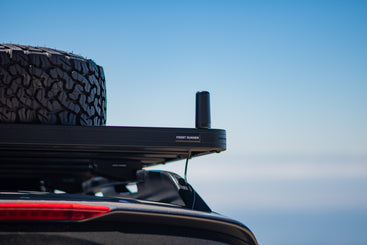
✓ Mount your antenna as high as possible for maximum range
✓ Keep bull bar antenna bases below the roofline for best performance
✓ Ensure mounting surfaces are bare metal for proper grounding
✓ Avoid installing fiberglass antennas on lip mounts
Cable Routing & Setup
✓ Route the cable through the firewall using a rubber grommet when possible
✓ Keep cables away from power, ignition, and electronics
✓ Do not over-tighten connections when attaching coax cables
✓ Avoid tightly coiling or bundling excess cable
Signal Performance Tips
✓ Keep antennas clear of light bars, roof racks, GPS units, and other obstructions
✓ Use ferrite beads to reduce interference
✓ Shorten cables properly with a PL259 connector if needed
✓ Secure cables with wraps or hooks (avoid zip ties)

Improve Range and Communication Performance
An antenna plays a critical role in how far and how clearly your radio can communicate. Upgrading or properly positioning your antenna can significantly improve range, especially in environments like forests, mountains, or rural areas.
Mobile and vehicle-mounted antennas offer the strongest performance, while compact antennas provide flexibility for portable setups. Choose the right antenna for your environment to get the most out of your Midland radio system.
Understand Antenna Performance
Antenna gain and design play a major role in range and signal strength. Understanding dB can help you choose the right antenna for your setup.
→ Read our guide to GMRS antennas and understanding dB